
As someone who has spent years analyzing the intersection of elite education and wealth management, I’m often asked the same question by frantic parents and ambitious students: “Is the $400,000 Ivy League price tag still worth it in 2026?”
With the total cost of attendance at institutions like UPenn and Dartmouth now exceeding $95,000 per year, the “prestige factor” is no longer enough to justify the investment for many. We need to talk about Return on Investment (ROI)—specifically, which majors translate into cold, hard cash within the first five years of entering the workforce.
In this analysis, we’ll strip away the ivy-covered aesthetics and look at the raw data: tuition vs. median earnings, the “Network Premium,” and the specific degrees that dominate the 2026 economy.
The New Reality of the “Ivy Premium”
The Ivy League isn’t a monolith. While the median ROI for a bachelor’s degree in the U.S. currently sits around $160,000 over a lifetime, elite institutions operate in a different stratosphere. However, even within the Ancient Eight, the disparity between a Computer Science major at Cornell and a Fine Arts major at Brown is staggering.
1. The Undisputed Kings: Computer Science & Computer Engineering
If you’re looking for the fastest path to a positive ROI, the tech sector remains the golden ticket.
- Top Performers: Princeton, Cornell, and Harvard.
- 5-Year Median Salary: $145,000 – $185,000
- The ROI Driver: In 2026, the demand for AI architecture and cybersecurity has pushed starting bonuses to record highs. A CS graduate from an Ivy League school often breaks even on their education costs within 3.5 to 5 years, assuming they don’t take on excessive private debt.
2. The Powerhouse: Finance & Applied Economics
There is a reason why the University of Pennsylvania (Wharton) and Columbia consistently top these lists. They are the primary feeders for Wall Street and global private equity.
- Top Performers: UPenn (Wharton), Columbia, and Yale.
- 5-Year Median Salary: $130,000 – $170,000 (excluding performance bonuses).
- The ROI Driver: The “Network Effect” is most potent here. While the curriculum might be similar to state schools, the access to hedge fund recruitment is what creates the high ROI. Finance degrees in 2026 have an average lifetime ROI of over 1,800%, making them the most cost-efficient choice for those with a high-income appetite.
3. The Specialized Specialist: Engineering (Aerospace & Chemical)
Engineering has always been a safe bet, but specialized Ivy programs—particularly at Cornell and Princeton—provide a unique edge in the green energy and aerospace sectors.
- 5-Year Median Salary: $115,000 – $140,000
- The ROI Driver: High starting salaries combined with high job security. Unlike tech, which can be cyclical, engineering roles in infrastructure and renewable energy have shown remarkable stability in the 2026 market.
The “Danger Zones”: Majors with Lagging ROI
It’s an uncomfortable truth: not all Ivy League degrees are created equal in the eyes of the IRS.
- Fine Arts, Education, and Psychology: While culturally invaluable, these degrees often show a negative ROI or a break-even point that stretches past the 15-year mark.
- The Data: A 2026 analysis shows that nearly 23% of bachelor’s programs yield a negative ROI when adjusted for the high cost of Ivy League tuition without significant financial aid.
The Financial Aid Paradox
We cannot discuss ROI without mentioning that most Ivy League students do not pay the “sticker price.”
With schools like Harvard and Princeton offering free tuition to families earning under $150,000 – $200,000, the ROI for a middle-class student can actually be higher at an Ivy than at a public state school. This “Net Price” reality is the secret weapon of the savvy Ivy League applicant.
Comparison Table: Ivy League ROI by Field (2026 Estimates)
| Field of Study | Avg. Starting Salary | 5-Year Median Salary | Est. Time to ROI |
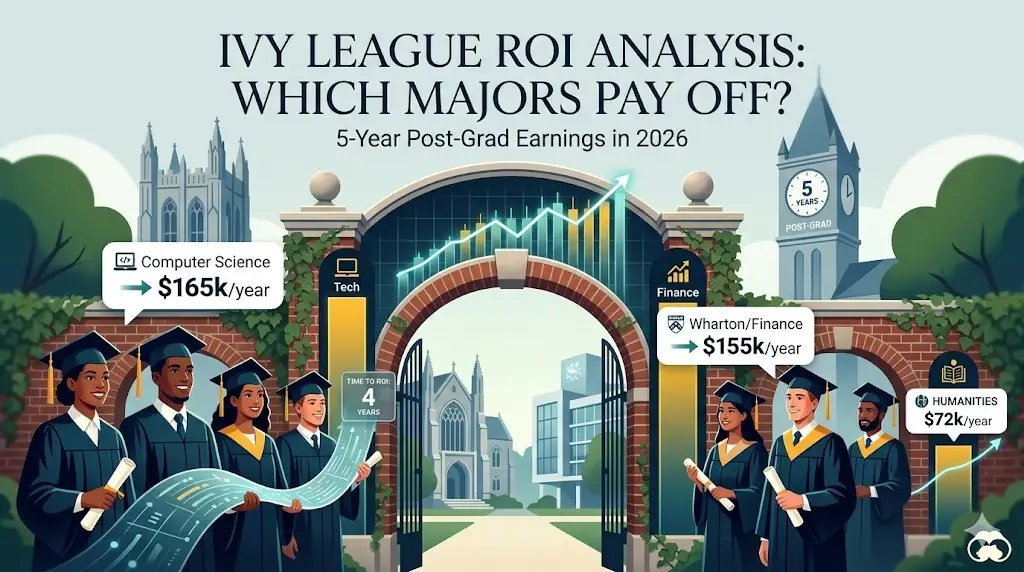
| Computer Science | $110,000 | $165,000 | 4 Years |
| Finance / Economics | $95,000 | $155,000 | 5 Years |
| Engineering | $88,000 | $125,000 | 6 Years |
| Nursing (BSN) | $82,000 | $110,000 | 6 Years |
| Social Sciences | $65,000 | $85,000 | 12+ Years |
| Humanities | $55,000 | $72,000 | 15+ Years |
My Final Verdict for 2026
If you are pursuing an Ivy League education as a purely financial investment, the quantitative fields are your only safe bet. The “prestige” of the nameplate will get you the interview, but the ROI is dictated by the market’s demand for technical and financial literacy.
For those entering the “Class of 2030,” the strategy is clear: focus on schools with the strongest financial aid packages (Princeton and Yale) and choose a major that leverages the institution’s industry connections.