
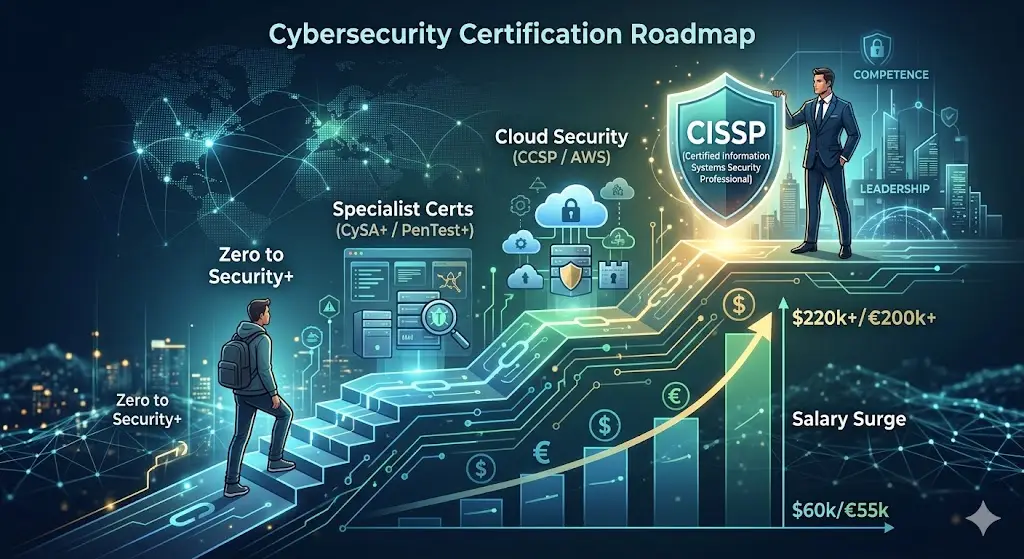
The digital gold rush of the 21st century isn’t in mining—it’s in defending. As someone who has spent years navigating the labyrinth of network protocols, cloud architecture, and risk management, I’ve seen firsthand how the right credentials can transform a career from a “job” into a high-octane wealth-building engine.
If you are looking to pivot into cybersecurity or accelerate your current trajectory in the US or European markets, you aren’t just looking for a badge. You are looking for the ROI. In this industry, your “Proof of Work” is your certification stack. Here is the definitive roadmap from entry-level enthusiast to the prestigious CISSP, with a cold, hard look at the salary milestones along the way.
Phase 1: The Ground Floor (CompTIA Security+)
Target Roles: Junior Help Desk, Junior SOC Analyst, Systems Administrator Expected Salary Range: $60,000 – $85,000 (€55,000 – €78,000)
Everyone starts somewhere. In the North American and EU markets, CompTIA Security+ is the undisputed “Golden Ticket” for entry-level professionals. It proves you understand the foundational language of security: threats, attacks, and vulnerabilities.
For a career changer, this certification is the catalyst that moves you past the HR filters. Without it, you’re competing with thousands; with it, you’re a “qualified candidate.”
- The Salary Jump: If you’re coming from a general IT background making $45k, the Security+ can instantly bump you into the $60k+ bracket. In tech hubs like Austin, Berlin, or London, that floor is often even higher due to the desperate need for “base-level” security hygiene.
Phase 2: The Specialist Ascent (CySA+ or PenTest+)
Target Roles: Cyber Security Analyst, Vulnerability Researcher, Tier 2 SOC Analyst Expected Salary Range: $85,000 – $115,000 (€78,000 – €105,000)
Once you’ve mastered the basics, the market demands specialization. This is where the “mid-career” surge happens. You have two primary paths here: Blue Team (Defense) or Red Team (Offense).
- CompTIA CySA+ (Cybersecurity Analyst): This is for the defenders. You’re learning behavioral analytics and how to hunt for threats inside a network.
- CompTIA PenTest+ or OSCP: This is for the offensive-minded. Offensive Security Certified Professional (OSCP) is particularly revered in the EU and US for its grueling, 24-hour hands-on exam.
Why the pay jump? At this level, you aren’t just following a checklist; you’re interpreting data. Companies pay a premium for professionals who can prevent a breach before it makes the front page of The Wall Street Journal.
Phase 3: The Cloud Integration (CCSP or AWS/Azure Security)
Target Roles: Cloud Security Architect, InfoSec Engineer Expected Salary Range: $120,000 – $155,000 (€110,000 – €142,000)
We no longer live in a world of on-premise servers. In 2026, if you aren’t “Cloud-Native,” you’re obsolete. Integrating a Certified Cloud Security Professional (CCSP) or platform-specific certs (like the AWS Certified Security Specialty) into your roadmap is like adding a turbocharger to your resume.
Cloud security professionals are currently among the most “recession-proof” roles in the Western market. Organizations are migrating massive data sets to the cloud and are terrified of misconfigured S3 buckets leading to data leaks. Being the person who secures that migration is worth six figures, easily.
Phase 4: The Pinnacle – CISSP (Certified Information Systems Security Professional)
Target Roles: CISO, IT Security Manager, Senior Security Consultant, Security Architect Expected Salary Range: $150,000 – $220,000+ (€135,000 – €200,000+)
This is it. The “Doctorate” of the cybersecurity world. The CISSP from (ISC)² is more than just a test; it’s a rigorous evaluation of your ability to manage a total security program.
The CISSP Requirements: You can’t just “study” for this and pass. You need five years of cumulative, paid work experience in two or more of the eight domains of the CISSP CBK.
The Financial Reality: In the US, the average salary for a CISSP holder often clears the $150k mark. In major financial centers like New York, Zurich, or London, experienced CISSPs acting as Chief Information Security Officers (CISOs) or Lead Architects can command total compensation packages (including bonuses and equity) exceeding $300,000.
Beyond the Numbers: Why the Gap is Widening
You might ask: Why is the salary jump so aggressive? It comes down to Risk vs. Cost. The average cost of a data breach in the US has climbed toward $5 million. For a Fortune 500 company, paying a CISSP $200,000 a year to mitigate a $5 million risk isn’t an expense—it’s a bargain.
Furthermore, the “Talent Gap” is real. There are currently hundreds of thousands of unfilled cybersecurity roles across North America and Europe. This supply-and-demand imbalance means that as you move up this roadmap, you gain immense “Negotiation Leverage.”
Strategy for Success: The “Stacking” Method
If you want to maximize your earnings, don’t just collect certifications—stack them strategically:
- Security+ to get your foot in the door.
- Specialty Cert (Cloud or PenTest) to prove your technical depth.
- CISSP to prove your leadership and strategic value.
Final Thoughts for the 2026 Market
The roadmap from zero to CISSP is a marathon, not a sprint. However, unlike many other industries, the path is clearly defined. If you put in the hours and secure the credentials, the Western market is ready to pay for your expertise.
The question isn’t whether cybersecurity is a lucrative career—it’s how fast you can climb the ladder to reach that six-figure peak.