
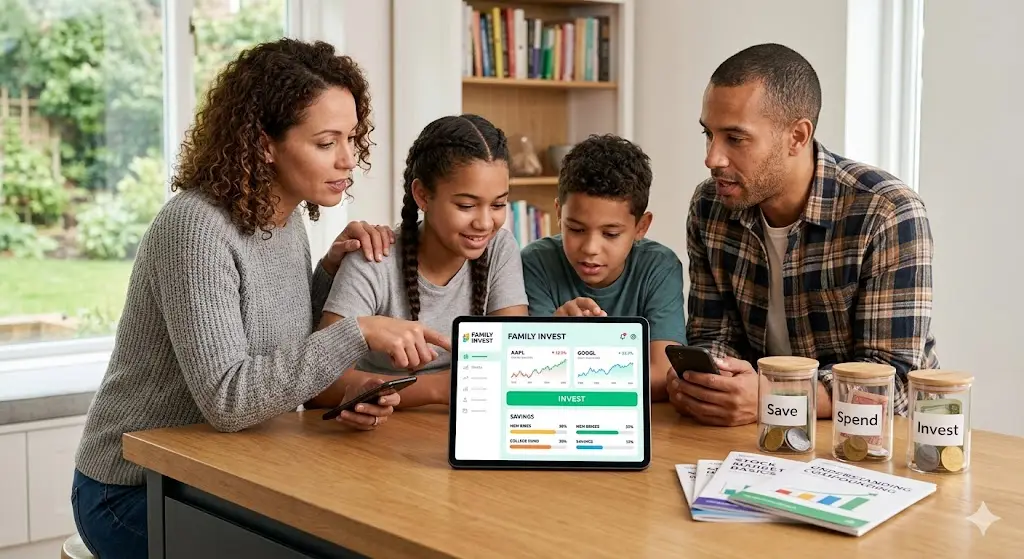
In today’s rapidly evolving digital economy, the old-school piggy bank has officially been retired. While dropping coins into a ceramic jar once taught us the basics of “saving for a rainy day,” it simply doesn’t cut it in a world defined by decentralized finance, fractional shares, and instant digital transactions. For parents in the US and Europe, the challenge has shifted: how do we prepare our children for a cashless society where the “value of a dollar” feels more abstract than ever?
The answer lies right in our pockets. FinTech (Financial Technology) has democratized the stock market and revolutionized personal banking, and it is now providing us with the ultimate classroom for our children. Here is a deep dive into how we, as modern parents, can leverage these tools to turn our teens into savvy investors and disciplined savers.
The Shift from Allowance to Assets
For years, the standard parenting move was a weekly cash allowance. But in an era where most of our transactions happen via Apple Pay or contactless cards, cash is becoming a foreign language to teenagers. If they don’t see the money leaving their hands, they don’t feel the “pain” of the purchase.
Modern FinTech apps designed for families—such as Greenlight, GoHenry, or Revolut <18—bridge this gap. They provide a tangible digital interface where kids can see their balance fluctuate in real-time. But the real magic isn’t just in the spending; it’s in the automated partitioning of funds.
As parents, we can set up “Silos” or “Buckets” within these apps:
- Spend: For everyday needs and small treats.
- Save: For long-term goals (like a first car or a high-end gaming PC).
- Give: For charitable donations.
- Invest: For building long-term wealth.
By automating a percentage of their “paycheck” (allowance or chores) into these categories, we are teaching the most fundamental rule of wealth: Pay yourself first.
Demystifying the Stock Market with Fractional Shares
One of the biggest hurdles to teaching kids about investing used to be the high barrier to entry. Buying a single share of a tech giant could cost hundreds or even thousands of dollars. For a teenager with $20, that’s an impossible dream.
Enter fractional shares. Platforms like Fidelity Youth, Charles Schwab, or Stockpile allow kids (with parental oversight) to buy $5 or $10 worth of their favorite companies. This is a game-changer for engagement.
Pro-Tip for Parents: Don’t start by lecturing them on P/E ratios or market caps. Start with what they know. Do they spend all day on Roblox? Do they love their Nike sneakers? Do they only eat at Chipotle? Helping them buy a tiny “piece” of those companies changes their psychology from consumer to owner.
When a teen owns a fraction of a company, they start paying attention to the news. They begin to understand that a new product launch or a global supply chain issue has a direct impact on their own “wealth.” This real-world connection is far more educational than any textbook.
The Power of Compound Interest: The “Parental Match”
We often tell our kids that “time is your greatest asset,” but to a 14-year-old, “ten years from now” feels like an eternity. To make the concept of compound interest hit home today, many parents are implementing a “Parental 401(k) Match.”
If your child decides to move money into their “Investment” or “Long-term Savings” bucket, offer to match it by 25% or 50%. This creates an immediate, visible reward for delayed gratification.
Why this works:
- It gamifies the saving process.
- It simulates the benefits of employer-sponsored retirement plans they will encounter later in life.
- It reinforces the idea that capital—when put to work—generates more capital.
Managing Risk in a “Get Rich Quick” Culture
We have to be honest: our kids are growing up in a world of “meme stocks” and crypto-influencers promising overnight riches on TikTok. This makes the parental role of “Chief Risk Officer” more important than ever.
Using FinTech apps allows us to have “The Risk Talk” using real data, not just theories. Most teen-focused investment apps offer “Watchlists.” Encourage your teen to put a “speculative” stock on their watchlist and track it for a month without buying. When they see that stock drop 20% in a week, it becomes a powerful lesson in volatility and the importance of diversification.
Teach them the “Boring is Beautiful” strategy: The core of their portfolio should be broad-based Index Funds or ETFs (Exchange Traded Funds) that track the entire market (like the S&P 500). Explain that while picking individual stocks is fun, the “index” is how real wealth is built over decades.
Security and Supervision: Staying in Control
As a parent, the idea of a 13-year-old having access to the stock market can be nerve-wracking. Fortunately, the “custodial” nature of these apps is robust.
- Approval Gates: Most apps allow you to receive a notification whenever your child wants to make a trade, requiring your digital “thumbs up” before the order is executed.
- Spending Limits: You can set daily limits on their debit cards to prevent “impulse buys” at the mall.
- Educational Modules: Many of these platforms have built-in quizzes and videos. Some even “pay” the kids in small amounts of stock or cash for completing financial literacy lessons.
Conclusion: Building a Legacy of Knowledge
Our goal isn’t necessarily to turn every child into a Wall Street hedge fund manager. Our goal is to ensure that when they leave our homes at 18, they aren’t intimidated by banks, they aren’t terrified of the market, and they aren’t susceptible to “get rich quick” schemes.
By integrating FinTech into our daily parenting routine, we are giving them a head start that previous generations simply didn’t have access to. We are moving from a culture of “don’t touch that, it’s for adults” to “here is how the world works—let’s build it together.”